How to Do a Breast Self-Exam: Step-by-Step Guide at Home
22 Oct 2026
Performing a self-exam for breast cancer is something most women feel uncertain about. We’re going to outline a simple process that should help build your confidence. Having a set routine of doing breast self-exams can bring peace of mind, especially when you know you're doing them the right way. This blog covers breast exams for home use in a simple, step by step guide.
What are the components of a breast self-exam?
For most women, this once-a-month examination at home is done while examining her breasts using both her hands and her eyes. With breast self-exams being so quick and convenient, women can easily do them while in the shower or even as they are getting ready for their day in the morning or as they are getting undressed in the evening.
Why are breast self-exams so important?
Women find most breast lumps themselves rather than having them found during doctor visits or imaging. It’s important to understand the typical feel of your breasts to know if there have been any changes, and the only way to know that is through a consistent monthly breast self-exam rather than only occasionally checking your breasts. Breast self-exams do not take the place of regular breast cancer screenings by a healthcare professional, like mammograms or clinical breast exams. However, for most women, they are often the first step in identifying breast abnormalities, and for some women, may be the only breast cancer screening they are able to access.
When to Do Your Breast Self-Exam?
- If you still have periods: Perform it for around three to five days following the end of your cycle. That’s the point in your cycle when hormones will have the least impact on the size and consistency of your breast tissue, leading to the least number of lumps and soreness.
- If you don't get periods (post-menopausal): You’ll want to select a particular day each month.
How to do the Breast Self-Exam?
To perform a monthly breast self-exam, a woman can follow this simple, three-step guide:
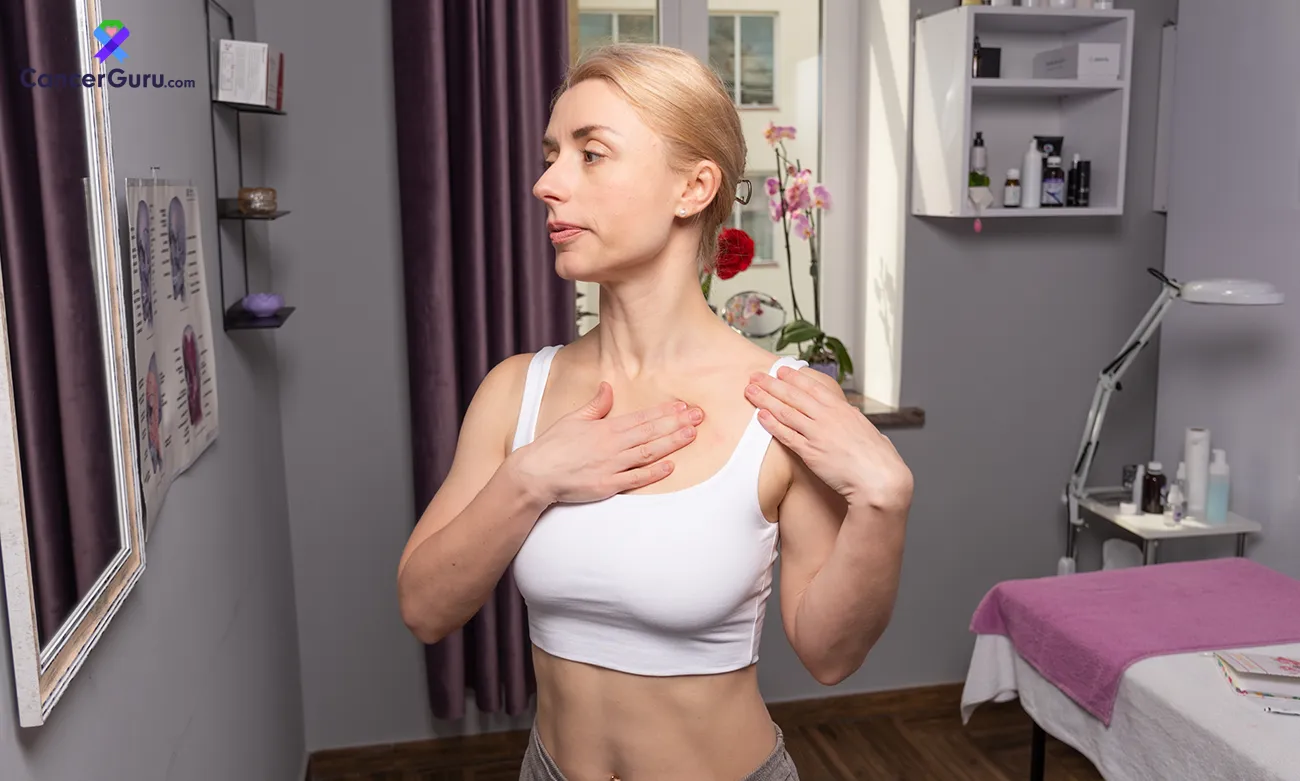
Step 1: How to visually examine your breasts
- Remove all upper body clothing, including your bra.
- Facing a mirror with your hands placed at the level of your hips.
- Observe any changes that may have occurred with the size, symmetry, shape, and/or volume of your breasts.
- Check for signs of dimpling, pitting, puckering, and/or redness of the breast tissue.
- Check your nipples and see if they look any different to you, if there has been any nipple discharge.
- Then raise your arms and again, observe your breasts.
Step 2: How to manually examine your breasts while standing
- Stay in front of your mirror and use your right hand to check your left breast.
- With the help of three middle fingers, feel your breast tissues by firmly pressing on every part of your breast and underarm area. Continue that process in a circular pattern to ensure you don’t miss any area.
- Check for texture changes, lumps, masses, thickened areas, and knots.
- Gently squeeze your nipples to check the unusual discharge.
- Now, repeat the inspection using your left hand for your right breast.
Step 3: How to Manually examine your breasts while lying down
- Lie face up on your bed or couch with a pillow tucked under your left shoulder. Then put your left hand behind your head.
- Use your right hand and examine your left breast again following the instructions in step 2.
- Switch and use your left hand to check your right breast.
What Changes Should You Watch During a Breast Self-Exam?
The goal of a monthly self-breast exam is to learn what your breasts normally look and feel like, and to report any new or unusual changes. It is not intended to diagnose breast cancer.
Keep a list of these symptoms to report to your doctor:
- A lump in the breast or underarm
- Any swelling
- Skin changes such as puckering or dimpling
- A rash, redness, or unexplained warmth
- New inward nipple change
- Persistent pain in a single spot
- A breast change that feels out of the ordinary
- Know the signs, but don’t assume it is breast cancer.
- Symptoms of breast cancer self-exam should not be ignored or diagnosed.
- However, it is always better to have them evaluated by a specialist, rather than trying to guess.
What are the Seven Ps of Breast Self-Examination?
The 7 Ps to help you conduct a self-exam. They are:
- Position: Look at your breasts with and without a shirt and then lie down.
- Perimeter: Include the area of your breast that extends to your armpit.
- Palpation: Move your three fingers in a gentle, circular motion.
- Pressure: Use light, medium, and firm pressure.
- Pattern: Go over every part of the breast to make sure you don’t miss anything.
- Practice: Perform self-exams regularly.
- Planning: Know what you’re looking for and what to do if something seems unusual.
What should you do if you find a breast lump or other changes?
It’s stressful to find a lump, but it is better not to get stressed. Cysts and fibroadenomas account for many lumps. Still, don’t ignore changes to your breast. New changes require a doctor’s or an oncology specialist’s exam. Further diagnostic tools can be used to investigate changes in the breast. These tools, which are easily available, can diagnose breast cancer at its early stage.
Why is Doctor Consultation Important for a Breast Self-Exam?
A self-exam detects a change, but it’s a doctor who explains the significance of that change. There are good reasons to consult a doctor, such as:
- Breast lumps are not always cancer.
- Not all cancers are present as lumps.
- Further assessment of changes in breast tissue is often needed.
- In some cases, diagnostic imaging including ultrasound, mammography and sometimes even an MRI, are required.
- There are even times when a tissue sample, or a biopsy, needs to be collected to confirm a diagnosis.
- A specialist can determine the significance of the changes to your breast.
When you notice a lump or changes to the breast, such as dimpling of the skin, discharge, or any other changes, it is better to not ignore the symptoms and wait for them to disappear on their own. In such situations, it is recommended to get the right tests to determine the course of action.
Can Men Develop Breast Cancer?
Male breast cancer is extremely rare. About one in 100 breast cancer diagnoses is in a man. There are symptoms to be on the lookout for such as a lump behind or around the nipple, or any sort of discharge from the nipple. Other things include changes to the skin of the chest area and an unexplained lump or swelling in the armpit. Male breast cancer can go undiagnosed for longer than female breast cancer because men don’t typically expect to develop the disease, however, it can and does happen.
Conclusion
The breast self-exam takes five minutes of a woman’s time every month and costs nothing. It isn't a replacement for formal screenings, but it does familiarize women with what is normal for them. When something new and unusual arises in the breast, she is going to be the first to know about it. Along with regularly visiting a physician and having annual mammograms beginning at 40 years old, this is a responsible, proactive approach to detecting early breast cancer.
Recent Posts
-
Ovarian Cancer Symptoms Women Often Miss
23 Sep 2026 -
Leukemia vs. Lymphoma: Key Differences Explained
14 Sep 2026 -

Returning to Work After Cancer Treatment
03 Sep 2026